
Last-Minute Revision: How My Brain Suddenly Learns Everything the Night Before Exams
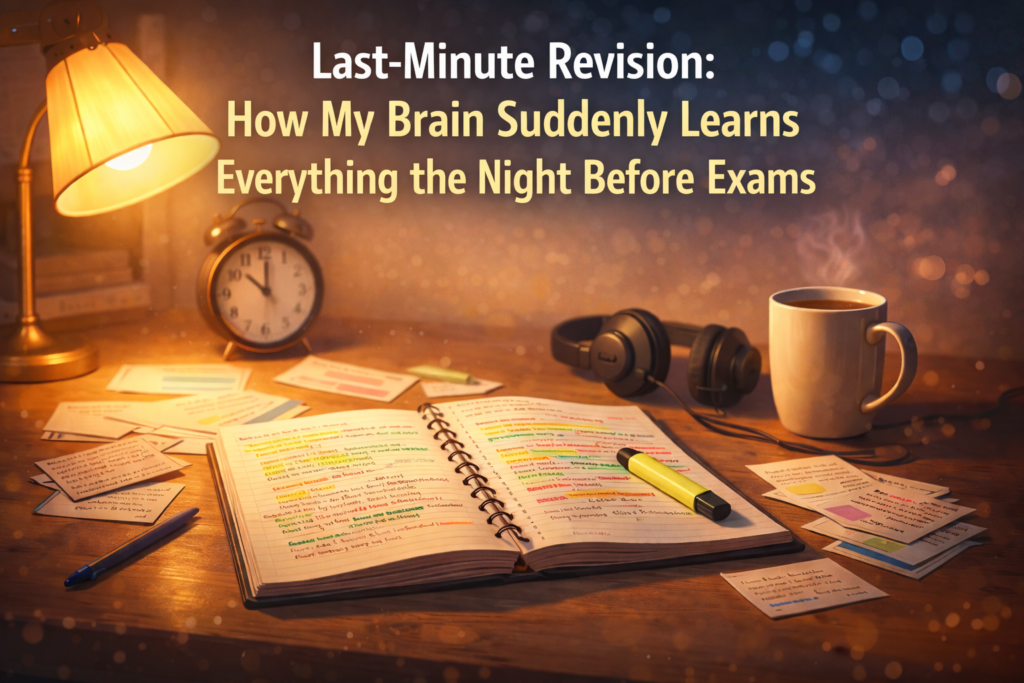
Have you ever opened your books days before the exam and understood nothing… but during last-minute revision, suddenly everything makes sense — formulas, diagrams, definitions, even the nonsense? If your brain learns best only the night before exams, you’re not alone.
Welcome to the 11:59 PM Brain Activation Phenomenon.
Scientists don’t talk about it enough, but every student has lived it.
And yes — there’s actually psychology behind this weird superpower.
Let’s break down why your brain behaves like a potato all semester… and then becomes Einstein the night before exams.
🧠 1. Panic = Turbo Mode for the Brain
When you realize the exam is tomorrow, your body releases adrenaline and cortisol — the same hormones used in survival situations.
Your brain at 4 PM: “Too tired.”
Your brain at midnight: “Tell me everything.”
Suddenly you:
-
remember concepts
-
focus like a laser
-
ignore distractions
-
become emotionally attached to your notes
Fear of failing > Motivation.
So yes, panic turbo mode is one of the biggest reasons last-minute revision sometimes works better than planned studying.
🔥 2. Emotional Stress Improves Memory
Normally, you read something → forget it in 10 minutes.
But before exams? You remember something you read ONCE at 2:13 AM.
Why? Because of emotional encoding.
When emotions are high (a.k.a. panic), your brain goes: “Oh this is important — SAVE IT.”
It’s not intelligence.
It’s survival.
🎯 3. Why Last-Minute Revision Forces Smart Prioritization
When you HAVE time, you waste it.
When you DON’T HAVE time, you suddenly become a strategist.
One night before exams, your brain automatically prioritizes:
-
important topics
-
past year questions
-
summaries
-
formulas
-
the teacher’s “this is very important” line
The syllabus hasn’t reduced — your filtering ability increased.
If you’re looking for smarter planning instead of panic planning, here’s a great read: Effective Time Management Tips for Busy Students.
⏳ 4. Short, Intense Bursts Help the Brain Remember More
Ironically, cramming works better than long study sessions (sometimes).
Because short bursts like:
-
25 minutes study + 5 minutes break
-
rapid summaries
-
repeated quick revision
match with how your brain stores information.
Your brain doesn’t like marathon studying.
It likes panic sprints.
💡 5. The Recency Effect = Fresh Information Sticks
This is why you can remember what you revised 5 minutes before entering the exam hall, but forget what you studied 3 days ago.
Your brain stores recent information in short-term memory, which is perfect for:
-
definitions
-
formulas
-
diagrams
-
dates
Basically: Freshness wins
Even though last-minute revision activates this special pressure-fueled superpower, it’s better to rely on it occasionally — not always.
If you want to learn how to restart studying even after days or weeks of not opening your books, check out this blog: 7 Easy Ways to Get Back to Studying After a Break.
⚠️ When This Superpower Fails
Let’s be honest — this method isn’t magic. It’s luck mixed with adrenaline.
It works for:
✔ Chapters you already know a little
✔ Memory-based subjects
✔ Concept revisions
It does NOT work for:
✘ Entire syllabus you never touched
✘ Subjects requiring deep understanding
✘ Math — where one step confusion = emotional damage
Last-minute revision = booster, not miracle.
⭐ Final Word
Your brain doesn’t hate studying.
It just needs pressure, fear, adrenaline, and a deadline hanging over its head.
But here’s the truth:
You’re not a bad student — you’re a deadline-powered student.
And while this midnight superpower is fun to rely on, don’t make it your lifestyle.
Use it as a backup — not a habit.
Even though last-minute revision activates this special pressure-fueled superpower, it’s better to rely on it occasionally — not always.
But if today is the night before the exam…
Good luck, genius. 😌📚
And if you want to stop depending on panic-powered studying and start building real study momentum, you might like this: 5 Tips to Trick Your Brain Into Studying (Even Without Motivation).

That 11:59 PM Brain Activation Phenomenon is so real – I always feel like I finally “get” things right before the test. It’s interesting how stress can suddenly unlock understanding, almost like needing a little pressure, which reminded me of the focus needed in a fast-paced game like the one described on https://tinyfun.io/game/ski-frenzy.